Saturday, 20 October 2012

Faster Horses, Please!


We are currently in the worst economic downturn since the Great Depression. This demands a response on a par with that of Keynes’s in the 1930s in terms of scale and imagination. Yet, the state of our nation’s finances means that we cannot spend or borrow our way to growth. Rather than being dependent on a financial industry that stretches no further than the boundaries of the City of London, we should look for new sources of growth in the industries of the future to secure a strong and sustainable recovery that brings the whole country with it.

In the wake of the financial crisis, it has become apparent that much of the economic growth we have enjoyed over the previous two decades was underwritten by an unsustainable credit bubble. The health of the whole economy became far too dependent upon the health of the financial services industry. Banking boomed, while the real economy, those in the business of making and selling products and services that the world actually needs, was ignored. The collapse of this arrangement has left us with a national debt of over £1 trillion, and an unsustainable deficit.   

The regions were also neglected during the boom years.  Between 1997 and 2010, Gross Value Added, a measure of output similar to GDP, rose by 61% across England’s northernmost regions, the North West, the North East and Yorkshire & Humberside. By contrast, in the South East and London, the centre of the financial services industry, Gross Value Added expanded by 92%. Moreover, whereas job creation in the South was spurred by a growing private service sector, the north has been heavily dependent upon government spending. Between 1998 and 2007, the state was directly or indirectly responsible for 64% of jobs created in the North, compared to only 38% in the South.

At the recent Labour Party Conference, Ed Miliband attempted to take on the mantle of One Nation Conservatism. However, Labour’s legacy speaks for itself. The direct consequence of Labour’s prawn cocktail offensive is that regions outside the South East of England were ignored and neglected by a party in government more interested in wooing financiers in the City. A truly One Nation response to the financial crisis would rebalance our economy away from London-centric banking and finance.

To do this, the government needs to support growth in new businesses and the industries of the future. Unlocking our innovation economy, and finding new engines for prosperity is vital for a sustainable recovery that is driven by growth in all parts of the country, not just central London. This means encouraging industries such as pharmaceuticals, energy, agricultural science and aerospace, which technology is reshaping into the building blocks of tomorrow’s knowledge economy, and where we already have a head start.

Although, Britain does not have the cheap labour of China, or India, it does have some of the finest universities and research establishments in the world, and a historically deep seated entrepreneurial spirit that saw our small island become the workshop of the world in the 19th century, exporting more goods across the globe than any other nation. Today, we should be using our know-how and passion for creativity and innovation to get strong foothold in emerging markets. With some emerging economies almost doubling in size every decade, our economic fortunes depend on developing strong trade links with them.

Take pharmaceuticals, for example. Having recently implemented better protection for intellectual property, India’s market for pharmaceuticals is expected to grow to $74 billion by 2020, and other developing countries are in a similar position. Even a small slice of this market represents a huge opportunity for growth for UK firms. Similar opportunities present themselves to our agricultural science sector. With the world’s population expected to rise to 9 billion over the next 30 years, agriculture around the world must use advances in technology to increase agricultural productivity. In these areas and others, the government must support British business in entering these markets, for example, through diplomacy and foreign policy, and making a commercial success out of British research.

Our lead in innovation is not just important in giving us an edge in emerging markets – it can even be harnessed to bring new, unforeseen markets into existence, and displace existing ones. Henry Ford said, “If I had asked people what they wanted, they would have said faster horses.” Yet, by developing the methods to mass-produce automobiles, Ford not only transformed people’s conceptions of what was possible, he also made the market for horse-drawn vehicles practically redundant.

Government cannot plan for innovation of this kind. To a large extent it is spontaneous and depends upon the genius and foresight of particular individuals. However, what government can do is create an environment that encourages innovation. First of all, the government should cut regulation to make it easier for entrepreneurs to start and operate businesses. Initiatives such as start up incubators, and hubs such as Tech City in East London, where entrepreneurs can collaborate and share ideas, should also be encouraged.

Our competitors, such as the US and Germany, are also investing in science, research and innovation. However, if we act now we can still unlock the full potential of our innovation economy, and make our advantages count. A focus on the knowledge-based economy, emerging markets and innovation will ensure growth is sustainable, and prepare Britain for the 21st century. Without it, any recovery we see in the next few years will be nothing but a false start on a broader path of long-term decline.  

Monday, 15 October 2012

Two Futures for America


In 2008, an electorate wide eyed with the sort of enthusiastic earnestness only Americans can affect, propelled Barrack Obama into the White House. In 2012, after four years of grandiose promises of “hope and change” running up against the realities modern government and a recalcitrant economy, that idealism has subsided. The 2012 Presidential election will be fought in a spirit of dispassionate realism.

This is something for which we should be grateful.  The last time two candidates were divided by such a wide gulf in terms of their vision for America’s future was 1964, when Barry Goldwater, a Republican with libertarian views, ran against LBJ. Goldwater carried only six states. Today there is less harmony in the electorate. Like the candidates, America itself is divided by an unbridgeable chasm on the direction in which America should be going. Better that Americans choose their path with their heads rather than their hearts.

Romney and Obama disagree on almost every area of policy. More so than anything on the issues at the centre of the election: the economy and the size of the state.  A Romney administration would be one that rolled back the frontiers of government. There would be lower taxes; drastically lower spending on just about everything but the military; and a balanced budget amendment to the constitution would also be on the table. Romney has also pledged to repeal (at least part of) Obama’s healthcare reforms. Nor is the rest of the welfare-state safe. Social Security and Medicaid, the healthcare program for the poor, would see deep cuts, while Medicare, the much beloved but completely unsustainable healthcare program for the elderly would be turned into a voucher scheme.       

Unsurprisingly, Obama disagrees with all of the above. Obama has presided over a fiscal stimulus program that has seen government spending reach levels unsurpassed since the Second World War; he has bailed out the car industry; and his healthcare reforms constitute an enormous rebuff to the power of the market in favour of the power of government. Though he too wants to reduce the deficit, his plan involves higher taxes and fewer loopholes for the wealthy, and less draconian spending cuts than Romney’s. His positive program, involving modestly higher spending on education and infrastructure hardly sets the world alight. Ironically, Obama has become the candidate of continuity and gradual progress, while Romney is the candidate of radical change - though, perhaps not of hope.

In other key areas the candidates are similarly divided. Romney wants a ban on gay marriage, and abortion in almost all circumstances. Indeed, Paul Ryan, Romney’s running mate, has co-sponsored a number of anti-abortion bills in the House of Representatives. Most ominously, the appropriately nicknamed “Let Women Die” Bill, which would have allowed hospitals to refuse women abortions, even when necessary to save their lives. Another, the Ultrasound Informed Consent Act, would have required women to be given a mandatory ultrasound involving an invasive vaginal probe before allowing an abortion to take place. Obama, on the other hand, put an ended the out-dated ‘don’t ask, don’t tell’ policy on gays in the military, and, after much vacillation, came out in favour of gay marriage. He has also signed into law legislation that makes it easier for women to sue for equal pay, and his healthcare reforms mandate that birth control should be offered to women at no extra-cost.

On foreign policy, Obama has sought to build bridges with those nations that were left out in the cold during the Bush era. On taking office he ‘reset’ relations with Russia, and he has attempted to position America at a distance from Israel, while reaching out to the Arabs. Neither policy has been successful. Romney, by contrast, intends to brand China as a currency speculator on his first day in office; he is more hawkish with respect to Iran; and he has already offended much of the Arab with his comments during his recent trip to Israel. Such an aggressive approach will do even more to damage America’s international position.

Perhaps the one area of policy that the two candidates agree on is the environment and energy. Both candidates essentially propose to change little. However, this is not a position converged upon through a shared perspective on the issues, but ankle-deep agreement on one goal: to get the economy moving. In an ideal world, Obama would like to do more to encourage renewables, and curb CO2 emissions. However, over the past 5 years there has been a boom in oil and gas, which has had more to do with technology and the market than government policy. Obama is loathe to put at risk one of the few healthy sectors of the US economy through burdensome legislation and taxes. For Romney and Ryan, the issue of climate change is simply too far down their agenda to matter.

The choice, in short, is between big government and small government. This may seem nothing out of the ordinary. However, with the rise of extreme movements such as the Tea Party, the candidates’ positions have become exaggerated caricatures of those that have been put forward in recent decades, with little common ground between. Once implemented, policies like Obamacare or the voucherisation of Medicare will be costly and difficult to reverse. This election, therefore, will determine the character of the US state for decades to come.  

Thursday, 4 October 2012

Better dead than Ed


At this week’s conference, the Labour Party have tried to show that Ed Miliband can make a tolerable Prime Minister. Earlier in the week, the focus was on trying to forge a personal connection between Ed and the electorate. One of Tony Blair’s great strengths was that many people thought of him as the kind of guy they wouldn’t mind having a pint with. Even David Cameron has a certain affability, despite his privileged background. Ed’s team have been trying to make it seem as if he isn’t all that weird and blinky, after all. Thus, we have seen the release of a rare family photograph, it which Ed looks thoroughly normal, as well a video stating the fact that Ed went to a state comp. As the conference progressed, there has been an attempt to communicate an alternative vision of Britain’s future to the Tory version of more cuts and austerity, culminating in Ed’s much lauded ‘One Nation’ speech.

The effort to make Ed Miliband electable, is by no means futile – I do think it possible. His very impressive speech has certainly bought him some time. However, ultimately I think Labour’s apparent strategy will fail. First of all, compare Ed Miliband to John Prescott – there is a world of difference between them. One is a genuinely working class politician, complete with regional accent, another is patently not. Ed Miliband’s father was an academic, he wrote books that are on the reading lists of any half-decent politics degree, Ed is clearly of the bourgeoisie; even if it is that part of the bourgeoisie that Marx described as the “small section of the ruling class [that] cuts itself adrift, and joins the revolutionary class.” Highlighting the fact that Ed went to a comprehensive will not be enough to convince most ordinary people that he has much in common with them.

Another flaw with the Labour Strategy is that Ed really is weird and blinky. Ed’s conference speech showed personality and charisma, but it was a 70 minute highlight in a two year omnisnore. Ed cannot win on personality unless this one brief spell of good form becomes consistent charm. His near constant inability to achieve this was fully demonstrated in his interview with Andrew Marr on Sunday. Asked about Labour’s new favourite buzz-word, “pre-distribution”, Ed opened with a terrible joke, telling Andrew Marr, apparently sarcastically, that he “loved” the concept. As he begins explaining it, he uses the words, “I’m very clear about this…” with increasing frequency, and no corresponding increase in clarity or lucidity. Quite the opposite. Then, failing to be pinned down to a simple definition of ‘pre-distribution’, he offers an appallingly vacuous definition along the lines of, “pre-distribution is about making the economy work for ordinary people”.

This brings me to the final problem. He has no substantive vision for Britain’s future that differentiates Labour from the Tories. On the major policy issue of our age, the economy, Labour would have practically the same austerity package as the Tories. Ed’s ‘one nation’ idea is utterly meaningless without some actual policies to flesh it out with. What makes it different from the Tory claim that ‘We’re all in this together’? Perhaps there is something to be said for not coming up with policies too early. Parties frequently get hung up on pledges made years in advance that are revealed to be impractical or foolish when they come into government; think of the Tory pledge not to restructure the NHS, or the Lib Dem promise not to raise tuition fees. However, there should still be some gesturing at what the policies might look like. When Brown was Prime Minister, the Tories positioned themselves as the party of austerity as opposed to stimulus without knowing where and when they would cut. We knew that they wanted to “cut red tape”, an appallingly vague phrase that still lets it be known that some regulations will be removed, even if they cannot say which ones. The ‘One Nation’ idea does not even do this.

Ed Miliband claims that ideas matter in politics, but this is nonsense if the ideas are devoid of any content.

Thursday, 13 September 2012

The Meaning of the Reshuffle


In the language of cabinet government, reshuffles can be used signal a change in direction, reinvigorate an ailing government, and, of course, to get rid of recalcitrant ministers. So what did David Cameron tell the country with his first reshuffle, last week? 

The political environment in which the reshuffle too place was a hostile one for the government. Early promise of radical reform to the public services, welfare and the constitution has turned into inertia. Though progress has been made on schools and welfare reform, the Government’s health and policing reforms have run into stiff opposition from the organisations the Government is trying to change. Meanwhile, each of the government’s proposed constitutional reforms – AV, elected mayors, equal-size constituencies and Lords reform - have floundered, leaving a bitter air between the coalition partners. At the same time, disgruntled Tory backbenchers are becoming noisier, their leadership having taken a younger, more left-wing mistress, in the form of Nick Clegg’s Liberal Democrats. All of these factors are magnified by the economic downturn, leaving Cameron’s government looking frail.

Political logic states that Cameron ought to have used the reshuffle to give the government new vigour in its weakest areas. Thus, we see Andrew Landsley, the man who has mishandled the health reforms replaced with the trustworthy and likeable Jeremy Hunt, shaking off some of the mud he accumulated over his support of Newscorp’s BSkyB takeover bid in the process. The government’s growth agenda is also at the fore of the reshuffle. Justine Greening, a West London MP was replaced as Transport Secretary by Patrick McLoughlin who has no constituency interests in Heathrow. Also in are the new planning minister, Nick Boles, whose think tank recommends building on the green belt, and the new Environment Secretary Owen Paterson, a proponent of shale gas.

The reshuffle also saw concessions being made to the Tory right. Ken Clarke, the doyen of the Tory left, loses his department in favour of the fiercely euro-sceptic Chris Grayling, while Michael Fallon moves in with Vince Cable at the Department for Business Innovation and Skills. Some commentators have argued that these concessions mark the end of Cameron’s modernisation project. However, this is a misreading. The fact that Cameron embarked on his detoxification project in the first place, shows that he understands the need to appeal to a broad cross-section of society, rather than the curmudgeonly Tory right. This is even truer in the new era of coalition politics, where the Tory leader must be seen as a man who liberals can do business with.

The message of this reshuffle is subtle. The government’s headline policies of austerity and school choice remain unchanged, Osbourne and Gove staying put. While new emphasis is placed on supply side reforms of planning, regulation and infrastructure to get growth. Despite apparent concessions to the right, unnoticed changes down the pecking order are more illuminating. Within days of her appointment as a junior health minister, Anna Soubry, who has also advocated the legalisation of cannabis in the past, gave an interview in The Times supporting voluntary euthanasia. Another new minister is Helen Grant, a former member of the Labour Party. Both liberal and female, Cameron’s modernisation project is very much intact. 

Tuesday, 17 July 2012

Lords Reform


The fact that Lords reform is the most intractable question in British politics is slightly puzzling. The pre-amble to the Parliament Act 1911, the act which first circumscribed the powers of the House of Lords, affirms “it is intended to substitute for the House of Lords as it at present exists a Second Chamber constituted on a popular instead of hereditary basis, but such substitution cannot be immediately brought into operation.” A century later, most Lords sit as a matter of appointment rather than birth; yet, the question of reform still lingers, and nor is it likely to go away until the composition of the House of Lords even begins to reflect the democratic principles that are taken as given in all advanced liberal democracies.

Though electing the House of Lords would unquestionably be in line with our democratic values, the quagmire that is Lords reform highlights an important truth: values and principles do not necessarily make for good government. Currently, the Lords acts as a repository of knowledge and expertise. Though many Peers were appointed based on how much money they donated to the Labour Party, the House of Lords still contains hundreds of people appointed due to eminence in their respective fields. This makes the Lords particularly effective at doing the things that the House of Commons either does not have the technical expertise to carry out, such as the work of the Lords Science and Technology Committee, or work that is not considered especially glamorous, such as scrutiny of EU legislation. How these functions could be retained with an elected chamber is difficult to see. Electioneering requires a different skill set, and attracts a different sort of person than those who currently inhabit the Lords. The likelihood is that an elected second chamber would simply replicate the functions of the Commons.

The trade off between pragmatism and principles is not new; almost every difficult political problem involves something like it. But Lords Reform is special because it is a question that is fundamental to the British constitution – by who and how our laws are made. We tend to think, in these matters at least, that principle should triumph: It is better to be a man of principle than unprincipled, and in the most important matters, principles should be followed.

Schumpeter - Political theorist
behindthe elite theory of
 democracy.
I am not so sure. Any reasonably adult moral outlook, which surely encompasses politics, as well as broader ethical life, cannot be enumerated by a short and pithy set of aphoristic principals. Lords reform does, I think, essentially boil down to a choice between democracy and elitism in our law making. When the people make their own laws they are autonomous, free and have the power to make their own destiny. When elites make the laws, you get better laws. The truth of the matter is that a good polity has great deal of both, which is pretty much what we have now. We already accept that monetary policy is determined by professional economists in the Bank of England, and that the detail of most policy and legislation is worked out by civil servants. It seems appropriate to me that the two houses of our legislature should represent a marriage of popular sovereignty, and elite rule – Government by the people tempered by government for the people.  

Saturday, 14 July 2012

Damien Hirst

In anticipation of going to see the Tate Modern’s Damien Hirst exhibition, last week I reposted a review I wrote a few months ago of the V&A’s Postmodernism exhibition. The time that has passed between then and sitting down to write this review is a good indication of how misplaced my anticipation was.

I will begin with the good things I have to say. 1000 Years – a partitioned glass box with flies hatching on one side, and a severed cow's head on the other, above which a bug zapper electrocutes scores of insects that have been lured over – comes early in the exhibition, and best represents all of the qualities of Hirst’s work I like. His Showmanship and unsanitized rawness - the stench of the box is perceptible through two vents in the glass if you get close enough. The Tate Modern has most of Hirst’s best works in these respects. The famed shark is on display, though it is less impressive than I expected. As is Mother and Child Divided, and Hirst’s giant ashtray, which gives off a heavy whiff of fag-ends, once more taking on the normally sterile setting that an art gallery presents. Perhaps the best piece of stagecraft is a room full of butterflies that hop from one person wearing brightly coloured clothing to another. This was such a draw that the gallery staff had to usher people along to prevent the butterfly room becoming overcrowded. A notable absence was For the Love of God, Hirst's diamond encrusted Skull. Although, the gift shop has been turned into an odd shrine to it, selling skull T-shirts, skull paperweights, skull notebooks, and so on. I suppose this was inevitable given that the skull touches on themes of capitalism, wealth and excess, but only served to highlight its absence.

Despite the number of works that are well worth seeing, the exhibition is littered with dull and boring twaddle. Infuriatingly this is repeated endlessly. Just when you think one medicine cabinet might have been enough, another appears, and then another. 20! 30! 50!!! Finally an entire Pharmacy is recreated. Then come the medical instruments – Scalpels and scissors by the dozen, replicated over and over. I must say, despite the number of spot paintings and butterfly paintings, they did not wear on me quite so much - some of them were exceptionally beautiful. However, once you have seen one medicine cabinet, you have seen them all. There was just so much of this exhibition that I could have quite happily walked past that it detracts from the good.

Hirst is a something of a contradiction. He has rightly earned a reputation for shock value and excitement by mutilating various animals, but the endless repetition of his works makes some of it monotonous and, quite frankly, boring. Similarly, this exhibition is, overall, a mixed bag. Go if you have an afternoon to kill in London. Otherwise, an emphatic "Meh!"

Friday, 13 July 2012

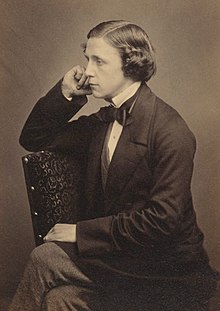
Lewis Carroll the Philosopher


Few people remember that as well as being a prolific author, Lewis Carroll was also an accomplished philosopher and logician. At the dawn of the 20th century, trying to elucidate the ‘foundations of mathematics’ had become something of a craze amongst mathematicians and philosophers. Simple truths such as 2+2=4 seem obvious and incontrovertible, yet the source of their truth is less concrete. Carroll's What the Tortoise Said to Achilles is one of the most insightful (and amusing) attempts to grapple with this foundational crisis.

In the article a pretentious tortoise challenges Achilles to use logic to force him to accept the conclusion of a logically valid argument:

       A. Things that are equal to the same are equal to each other.
       B. The two sides of this triangle are equal to the same.

       Z. The two sides of this triangle are equal to each other.

The tortoise claims to accept the first two propositions, but not the third. Achilles takes up the challenge of trying to set the tortoise straight. First, he points out that if somebody accepts A and B, then they must also accept Z. This seems quite sensible to the tortoise, so he adds it to his premises.

       A. Things that are equal to the same are equal to each other.
       B. The two sides of this triangle are equal to the same.
       C. If somebody accepts A and B, then they must also accept Z.
   
       Z. The two sides of this triangle are equal to each other.

The tortoise, unconvinced, claims to accept A, B and C, but not Z. Achilles, seeing triumph is in reach, exclaims, “Aha! If A and B and C are true, Z must be true.” Here, the beginnings of an infinite regress are apparent. The tortoise seems to have a point. Though we would normally simply accept the move from A and B to Z, the intermediate steps all seem necessary to license the inference, even though we would not normally state them; indeed, they are the sort of things we would say if we were teaching a child to reason.

Wittgenstein’s response to this paradox was to say that when we follow a rule, such as a rule of inference, it cannot be the case that we require intermediate steps, or interpretations of the rules, such as C, to lead us along. If it were, then we would never get anywhere, as Carroll’s paper shows, for "any interpretation still hangs in the air along with what it interprets, and cannot give it any support” (Wittgenstein’s Philosophical Investigations, §198). Instead, human beings, being the sort of creatures we are, when we have been given the appropriate training, we see immediately, without interpretation or further premises, that Z follows from A and B. This is what comes naturally to most people after minimal instruction. To somebody like the tortoise, who despite plenty of instructions and illustrations, cannot be brought to see that Z follows from the premises, there is nothing to do but say, “I am sorry, but I cannot make you understand.”

This solution to how it is we are able to go by a rule, which I think is the right one, does not leave us with much less of a sense that mathematics - indeed, any rule based practice - is a precarious affair. There is nothing more underlying the fact that 2+2=4 than the contingencies of human nature; the fact that because of the things most humans share - biology, culture (in a very broad sense), primitive desires, ect., - when it comes to mathematics we mostly find it more natural to go on in one way rather than another.

Given that Carroll foreshadows the most celebrated philosopher of the 20th century, amongst the puzzles his paper raises is - Why is Carroll not regarded as highly in philosophical circles as he is in literary circles?